
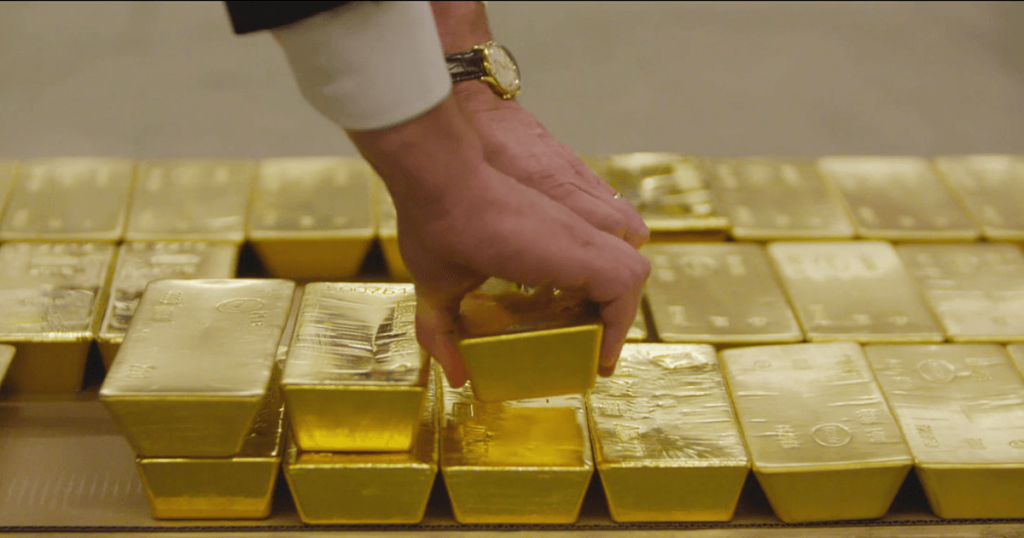
Gold’s 2025 rally has been spectacular. Prices surged above US$4,000 per ounce in October, doubling in less than two years as geopolitical tensions and macro-uncertainty sent investors scrambling for safe havens. Beneath the headline prices is a quiet but powerful driver: the official sector. Central banks have purchased more than 1,000 tonnes of gold every year since 2022, and they continue to buy despite record prices. This article explores why the buyers of last resort have become buyers of first resort, what they’re buying, and what it means for investors.
A catalyst: sanctions and the weaponisation of reserves
The modern gold rush began in February 2022, when Western governments froze about US$300 billion of Russia’s foreign‑currency reserves following its invasion of Ukraine. For many reserve managers, it shattered the idea that sovereign reserves were off-limits, dollar or euro assets could be frozen or taken whenever political decisions demanded it. In October 2025, the European Commission proposed using €185 billion of frozen Russian assets to fund aid to Ukraine, reinforcing fears that reserves can be politicised. Reuters noted that “Russia has been denied access to its own money. Central bankers around the world know this and they are acting accordingly… acquiring more gold”. Gold has no issuer or counterparty – it cannot be sanctioned or defaulted on. That simple fact has turbo‑charged official-sector demand.
A study by the European Central Bank (ECB) describes how central banks view gold as a long‑term store of value, an inflation hedge, and a crisis asset. Surveyed reserve managers cited performance during crises, diversification and protection against geopolitical risk as key reasons to hold gold. The same report found that concerns about sanctions and the erosion of major currencies were cited by roughly one in four emerging-market central banks as determinants of their gold holdings. In other words, the political dimension of reserves has become inseparable from portfolio management.
Record‑breaking volumes: the hard numbers
The World Gold Council’s (WGC) Gold Demand Trends report shows that central banks added 1,045 tonnes of gold to global reserves in 2024, the third consecutive year above 1,000 t. That compares with an annual average of around 473 t between 2010 and 2021. Consultancy Metals Focus estimates that official purchases reached 1,086 t in 2024 and forecasts demand of roughly 1,000 t in 2025. Central banks have now been net buyers for 15 straight years.
The pace has slowed slightly in 2025. Large price gains deterred some tactical buying, but it remains well above historical norms. WGC data show that central banks bought a net 220 t in Q3 2025, a 28 % increase from the previous quarter. Year-to-date purchases totalled 634 t, lower than the 724 t bought in the first three quarters of 2024 but well above the pre‑2022 annual average of 400-500 t. Reported monthly statistics show a rebound in late summer: central banks added 19 t in August 2025, up from 11 t in July. By the end of August, they had bought 444 t so far in 2025.
Who’s buying?
The mix of countries buying gold highlights how reserve strategies are being driven by geopolitics. In 2024, the National Bank of Poland (NBP) was the largest named buyer, adding 90t and bringing its holdings to 448t, roughly 17% of its total reserves. The Reserve Bank of India bought 73t, more than four times its 2023 purchases. Other notable 2024 buyers included the Central Bank of Hungary (16t), Turkey (75t), Serbia (8t), and Georgia (7t). The People’s Bank of China (PBoC) reported purchasing 44t in 2024, leaving its holdings at 2,280t.
In 2025, purchases remain broad-based. During Q3 2025, the biggest buyers were Kazakhstan (18t) and Brazil (15t), with Turkey adding 7t, Guatemala 6t and a long tail of emerging economies buying 1-6t each. Poland, still the largest buyer year-to-date, paused purchasing after May but announced it would raise its target gold share from 20% to 30% of reserves. The WGC notes that seven central banks boosted reserves in August 2025, with Kazakhstan leading (8t) and Bulgaria, El Salvador, China, Uzbekistan, Ghana, Indonesia and the Czech Republic each adding 2 t. Russia was the only reported seller, likely for coin minting.
Overall, these purchases have lifted official gold reserves to roughly 36,000 t, according to a Reuters study. Remarkably, gold has surpassed the euro to become the second‑largest global reserve asset after the U.S. dollar. Central banks’ holdings are now worth around US$4.5 trillion – more than their US$3.5 trillion in U.S. Treasuries – and gold represents about 27 % of global reserves, while Treasuries’ share has slipped to 23 %. The last time gold’s share exceeded that of Treasuries was in 1996.
Why are they buying?
Survey evidence helps explain this structural shift. The WGC’s 2025 Central Bank Gold Reserves Survey, which collected responses from 73 central banks, found that 95 % of respondents believe global official gold reserves will increase over the next 12 months, and 43 % expect their own holdings to rise. Only 7 % expect a decrease. A majority (73 %) foresee moderate or significantly lower U.S. dollar holdings over the next five years, while many expect the share of other currencies and gold to increase. Reserve managers cited gold’s crisis performance, diversification benefits, inflation hedging and the default/sanction risk associated with fiat reserves as motivations. The ECB notes that since Russia invaded Ukraine, countries geopolitically aligned with China and Russia have significantly increased the share of gold in their reserves.
Geopolitical drivers also vary by country. For Poland, the war in neighbouring Ukraine created a sense of urgency; the NBP’s president publicly stated a desire to lift gold reserves to 20 % (and now 30 %) of reserves. Turkey added 75 t in 2024 and continued buying in 2025, partly to support domestic financial stability. India has been steadily building reserves both as a hedge against U.S. sanctions and to diversify away from the dollar. China’s motives are opaque, but its ongoing accumulation (11 consecutive months of reported purchases as of September 2025) reflects long-standing efforts to internationalise the renminbi and reduce dependence on U.S. assets.
How official buying affects the market
Central‑bank demand is largely price-insensitive, meaning that even high prices do not deter strategic purchases. This behaviour tightens available supply and “smooths sell-offs”, helping explain why gold has hit record highs despite weak jewellery consumption in some regions. The WGC estimates that central banks accounted for more than 20 % of total gold demand in 2024, double their average share in the 2010s. Official-sector buying thus acts as a floor under prices; 2024 saw gold demand reach a record 4,974 t, despite an 11 % drop in jewellery consumption.
There is evidence that official purchases crowd out other forms of demand when prices soar. The WGC noted that jewellery consumption was pressured in 2024 and Q3 2025, yet investment demand – bars, coins and especially ETFs – rose sharply. The Nasdaq/INN review of Q3 2025 notes that Western investors drove record ETF inflows of US$26 billion, but central‑bank buying remained the third‑largest category of demand after jewellery and investment. Analysts, therefore, view central bank buying as amplifying price rallies but also cushioning corrections.
Implications for investors
For individuals and institutions, the official sector’s gold rush has two key takeaways. First, gold’s role in portfolios is changing from a tactical hedge to a strategic allocation. When central banks hold more gold than Treasuries and signal continued purchases, they provide a durable bid that can support higher long‑term prices. Allocating a small percentage (e.g., 5-10 %) of a diversified portfolio to gold may help hedge against geopolitical shocks, currency debasement and real-yield volatility. However, investors should still monitor real interest rates – historically, falling real yields have been positively correlated with gold prices, although this link weakened after 2022.
Second, be careful not to conflate gold with gold miners. Mining equities carry operational risks – labour, energy costs, political risk – that can swamp the safe‑haven qualities of bullion. Royalty and streaming companies offer exposure to gold price movements with lower operating leverage, but they are still equities. To mirror central bank behaviour, investors seeking safe‑haven characteristics should focus on physical gold or physically backed ETFs. Tokenised gold and on‑chain products are emerging alternatives, but custody, audit and issuer risk must be examined.
What could change the trend?
Several factors could slow or reverse central bank gold buying:
Higher real interest rates. If central banks (particularly the Federal Reserve) raise real rates significantly, the opportunity cost of holding zero-yielding gold would rise. History shows that gold tends to underperform when real yields climb.
De-escalation of geopolitical tensions. The current demand surge is rooted in war, sanctions and trade conflicts. A credible resolution to major conflicts and a more predictable U.S. policy stance could reduce the perceived need for sanction-proof assets.
Policy reversals by key buyers. The WGC emphasises that country‑level data are often opaque and can change quickly: some central banks, such as Kazakhstan and the Philippines, have sold gold tactically. A sharp reversal by major buyers like China or Poland could temporarily pressure prices.
Persistent high prices leading to demand destruction. There are signs that record prices are suppressing jewellery demand and encouraging scrap supply. If the central banks’ buying also slows, the market may become more sensitive to demand destruction.
Overall, however, none of these headwinds appears imminent. The ECB notes that official demand has lifted gold to its highest share of reserves since Bretton Woods, and Reuters observes that central banks now hold more gold than U.S. Treasuries for the first time since 1996. The structural forces driving this shift – geopolitical fragmentation, sanctions risk, and dissatisfaction with dollar dominance – are unlikely to dissipate soon. Investors would be wise to take note: when the buyers of last resort turn into buyers of first resort, the rules of the market change.
-Andri Hall