

On April 11th, 2024, billionaire businesswoman Truong My Lan was sentenced to death for her role in the largest financial fraud in Vietnamese history. She was convicted of embezzling more than $12bn, that’s $4bn more than the fraud of Sam Bankman-Fried. This October, she was also convicted of raising $1.2bn through illegally issued bonds, laundering $18.1bn, and unlawfully transferring $4.5bn through Vietnam’s borders. She was sentenced to life imprisonment, alongside her death sentence.
Who is Truong My Lan?
Truong My Lan was born in Ho Chi Minh City on October 13th, 1956. In her youth, she worked for her family’s hair accessory business in the Ben Thanh Market. In the 80s, Vietnam opened up to foreign direct investment, trying to copy the China model by capitalising on their cheap labour.
In 1991, Lan founded a real estate development company, Vạn Thịnh Phát Group (VTP), which quickly became one of Vietnam’s largest real estate developers. In 2011, she merged the Saigon Commercial Bank, First Bank, and Tin Nghia Bank into Sai Gon Joint Stock Commercial Bank (SCB). Under Vietnamese law, a person cannot own over 5% of a bank’s stock; however, prosecutors found that Lan owned around 90% of SCB (Bloomberg Originals, 2024).
Fraud in Vietnam
For two decades, Vietnam has been one of the fastest-growing economies in the South Asian region, and the number of millionaires has also increased dramatically. With this, a culture of misconduct also appeared. To increase investment and international trust in Vietnam, the government launched the ongoing “blazing furnace” (đốt lò) anti-corruption campaign in 2016. The campaign has arrested high-ranking government officials and businesspeople and forced the resignation of two presidents and two deputy prime ministers (BBC, 2024).
The fraud
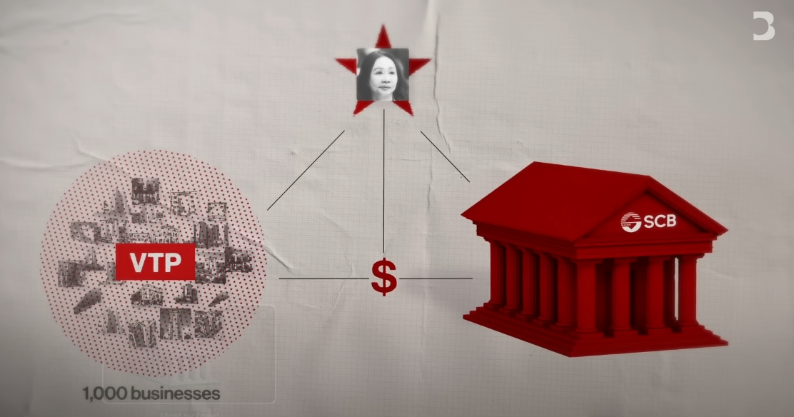 With both the VTP and SCB under her control, she made a network of over 1,000 shadow companies to fund her property development company, VTP, which applied for illegitimate loans and collateral payments in SCB. The applications were accepted, and funds were either picked up in cash or directly transferred into the bank account of the shell company (MINGTIANDI, 2024).
In 2022, Lan was arrested on illegal bond charges. The arrest had a direct effect on SCB, with investors dumping the bank’s stock and customers withdrawing their funds. The court ruled that SCB had issued ~$43bn in loans to Lan and her accomplices, which is around 11% of Vietnam’s GDP in 2022 (Bloomberg Originals, 2024).
Alongside Lan, 86 other people were found guilty of participating in the fraud, including her husband, Eric Chu Nap-Kee, who was found guilty of breaching banking regulations to coordinate the fraud with his wife. He received a sentence of 9 years in prison. Lan’s niece, Truong Hue Van, who was the CEO of VTP, has also been charged and will serve a sentence of 17 years. In the trial, Van tried to downplay her involvement in the fraud, claiming that she did not participate in any meetings discussing the conspiracy and just followed directions from “above” and signed the right documents (VnExpress, 2024).
The consequences
While government officials argue for the rigorous anti-corruption campaign, it has significantly slowed down the bureaucratic process within Vietnam. Peter Ryder, chairman of Indochina Capital, states: “The anti-corruption campaign has definitely had an impact. What used to take three months to get approval now takes 12 months, if not longer” (Bloomberg Originals, 2024). Despite this, investment in the country has still been steadily on the rise.
The punishment of Truong My Lan serves as a warning to not mess with the Communist Party of Vietnam. The country’s judiciary system has long been criticized for not being fully transparent with its rulings, and it seems that the country is using this to their advantage by striking hard against offenders. The Vietnamese government’s “blazing furnace” anti-corruption campaign, while slowing bureaucratic processes, demonstrates a strong commitment to rooting out corruption and restoring trust in the nation’s economic systems. The severe penalties handed down to Lan and her accomplices serve as a powerful deterrent and a clear message that financial fraud will not be tolerated.
– Arturs Kamaruts