
First of all, we should ask the question, “Do you know anyone who hasn’t heard of Pokemon”, most probably you cannot even imagine a person who wouldn’t have heard of Pokemon, but we can then ask another question “How much you know about Pokemon”. Even though everyone has heard of Pokemon and most probably about the most expensive Pokemon card – the population 1 PSA 10 Illustrator Pikachu which was bought by YouTube influencer Logan Paul in 2022 at a valuation of 5.275 million dollars, not many of us know much about it behind the surface level, while you might know that Pokemon have cartoons, movies, games, and in what we are most interested in, trading cards, which have produced a whole new market with great investment opportunities, and Pokemon trading cards have become the main contributor for whole trading cards industry, but do you know how it works. The Pokemon trading card market has grown very rapidly especially over the last few years, having even 10 billion high annual growth rates, and as of today having more than 53 billion cards produced.
When talking about the Pokemon trading cards market, we should first have to understand what the market consists of and how it works. As other kinds of trading cards work, Pokemon trading cards also have buyable packs and bundles with different sets mainly changing over time. One might even say that this is a legal kind of gambling.
First, we should know that these cards were made as part of the Pokemon Trading Cards game, but due to their popularity and good investment returns, apart from players of the game and collectors, also people with investment in mind have emerged. One of the main factors is great annual and longer period ROI and CAGR (Compound Annual Growth Rate), on average having 15-25% high annual CAGR.

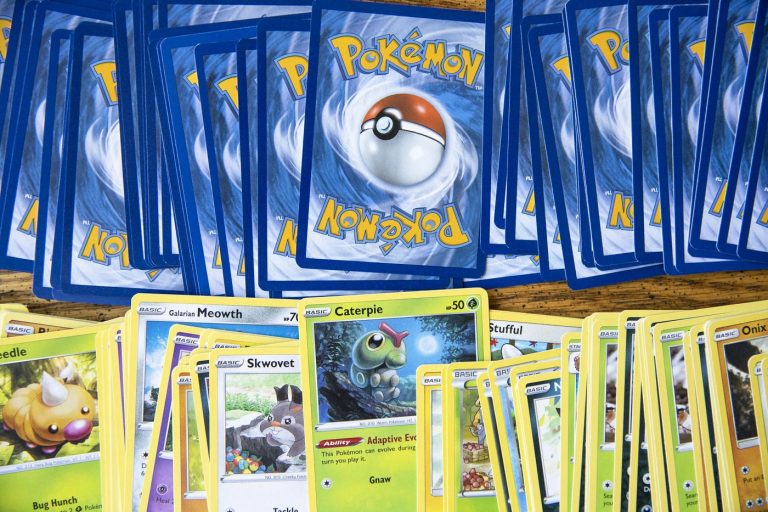
The basics of Pokémon cards can be placed into three categories: Pokemon cards (the kind that we are mostly interested in), trainer cards, and energy cards. You might already understand that Pokemon cards refer to cards with Pokemon on them, and are the main type of cards that are collected, the main difference between Pokemon cards being their rarity. There are three types of basic rarities – common (as seen in the picture), uncommon and rare cards. As names already suggest common type you will get more of and rare type you will get less of from these three rarities, which mainly is the price driver, because of more limited supply. Mainly you can spot the difference while looking at the bottom righthand corner, common cards will have a black circle, uncommon cards will have a black diamond, but rare cards will have a black star.
Additionally, to these rarities there are a few more – holographic rare which has a black star and shiny Pokemon picture; reverse holographic rare which consists of a black star and shiny card apart from a Pokemon picture; and ultra-rare which has a black star as well, but to describe it otherwise is a lot harder, but when you will see it you will know as it will look much different than any other kind of Pokemon card. Besides these, there are also several other rarities, promotional cards (a card that will only be offered as part of a certain promotion, as well as design differences), secret rare cards (index number of the card larger than the size of the set, also can be seen at the bottom right-hand corner) and fixed rarity cards(same rarity throughout the set). Other kinds of cards are Trainer cards that support Pokemons throughout the battle and energy cards that are used to show what energy they provide for your Pokemon in play.
Different factors influence Pokemon trading card price, but the main factors are the condition of the card, the rarity of the card, the character’s popularity, the strength of the card, and some external factors that increase the popularity of the card, for example, some promotion from some well-known person. As mentioned before Pokemon trading cards have seen great ROI and market growth, but one very interesting fact is that the PWCC Top 500 Index (a Pokémon card index) had a 10-year ROI that was 94% higher than the S&P 500 over the same period, which only further suggests the strength of this investment. Of course, these are the top cards and might not paint the whole picture, but a few other annual statistics show that even by buying the worst investment option, modern cards you will seek great CAGR.
- Overall market CAGR (2018–2023): Estimated 15–25% annually
- Vintage cards CAGR (1999–2023): 20–40% annually for rare cards
- Modern cards CAGR (2015–2023): 5–20% annually
- Sealed product CAGR (2010–2023): 15–35% annually
Even though Pokemon trading cards are and have been a great investment recently there have been a few doubts about the market, because of the recent saturation of the market.
Regarding the ways to know the price of your cards, you should look at the internet, namely, eBay, or PSA Card Facts or ask people who know something about it. EBay and local trading gatherings also will be the most probable ways you will see people sell and buy the cards.
In conclusion, Pokemon trading cards are still a great investment opportunity, but some consideration still would be necessary regarding the whole market. The best way would be to diversify your portfolio, and most importantly invest in vintage cards, preferably in a good state, and although they might get a little pricey they are the safest and most effective investment.
– Marts Mihailovs