
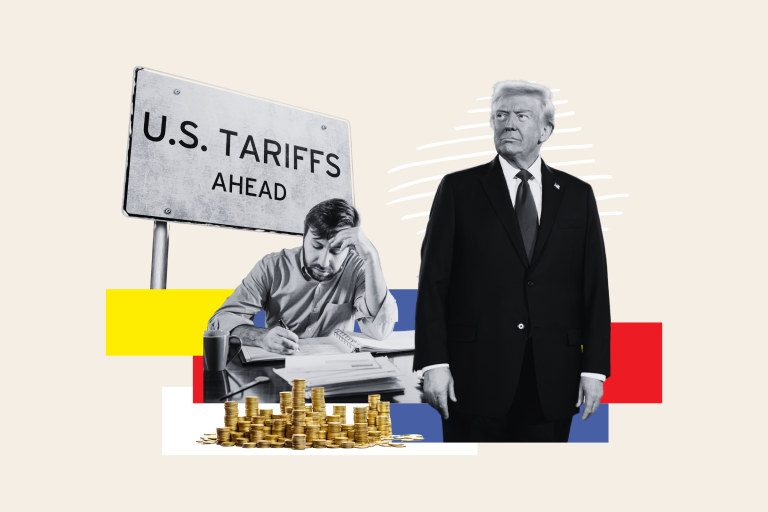
As Donald J. Trump begins his second term as the 47th president of the United States, he faces a long list of promises from his campaign yet to be fulfilled. One of his most notable agenda items is a plan for significant income tax cuts over the next four years. As a rational reader, you might assume such aggressive shifts in fiscal policy could drastically increase the budget deficit—and you’d be correct, at least in theory.
According to the latest IMF report, the U.S. structural budget balance deficit now stands at a staggering −2.2 trillion dollars as of 2024, marking an approximate 1366.7% increase since the start of the millennium. To at least slow down the snowballing debt, President Trump has a one-word answer: tariffs. This fiscal policy tool has a simple purpose. In essence, tariffs are additional taxes imposed on imported goods, mainly used to boost the competitiveness of domestic industries. However, Trump’s approach has some major inefficiencies in his action plan. The same group of people, with absolutely disproportionate trade-offs, would serve as both beneficiary and benefactor in his plan—the domestic consumer.
The policy’s efficiency could, in fact, be so poor that even Pareto would be rolling over in his grave. Allow me to illustrate this. Suppose Trump imposes a 20% tariff on apparel imports from China to boost the U.S. apparel industry—a plausible scenario, given his intention to recapture market share from his fellow Asian partners. For China, the deal doesn’t change much; they continue selling T-shirts to the U.S. for $10 a piece. But for the domestic importer—let’s call them Binco & Clo—the cost rises. They typically apply a 20% markup, making their usual retail price $12 per T-shirt. With the new tariff, however, Binco & Clo must now pay an additional $2 in tariffs per shirt, bringing their cost up and effectively eliminating their profit margin. To survive, they’ll have to raise the retail price to $14.40 to keep their 20% margin.
You can see where this is heading. This price increase, otherwise known as inflation, is a predictable outcome of such an aggressive fiscal intervention. And as history shows, tax cuts rarely outpace the impact of inflation. This approach creates a disproportionate trade-off: while consumers may save money through lower income taxes (covered by tariff revenue), they face significantly higher prices on everyday basket of goods. Following the 2018 Trump’s Tax Cuts and Jobs Act, the long-run inflation’s toll was temporarily offset by a slowdown in economic activity during the COVID-19 pandemic. Today, however, inflation remains above the Fed’s 2% target, currently at 2.99%, down from 4.13% in 2023 (IMF data).
Although Jerome Powell, head of the U.S. Federal Reserve, has announced a recent rate cut of 25 basis points (from a range of 5%–4.75% down to 4.75%–4.5%), Trump’s new tariff strategy and ongoing inflation make it likely that the Fed will need to tighten monetary policy in the long run. Powell’s remarks about an “inflationary economic agenda” do not add any optimism to the situation. Higher U.S. rates could spill over into the European economy as the European Central Bank (ECB) responds to maintain economic balance, potentially slowing growth in both regions. Unlike the Fed, the ECB does not operate under a dual mandate of low inflation and low unemployment. As a result, rising unemployment could become a more prominent feature in Europe’s response to inflation, forming a key part of its inflation-control strategy.
Ultimately, the U.S. may not be prepared for such bold fiscal policy changes. Higher labor costs and insufficient raw material availability hinder American producers from reaching the production efficiency seen in Asia. Perhaps a gradual “tariffication” of imported finished goods could be a first step—allowing American producers fair access to un-tariffed resources before reclaiming market share. One thing remains clear: the end consumer will bear the burden, and the trade-offs are likely to be disproportionate relative to their net benefit.
– Dario Bassils