
Ozempic, developed by Danish pharmaceutical company Novo Nordisk in 2017, was originally designed to manage type 2 diabetes by helping regulate blood sugar. Recently, however, it has surged in popularity as an easy weight-loss option, capturing huge public and media attention.
With millions turning to Ozempic for its slimming effects, Novo Nordisk has seen its stock perform better and slowly climb up. This unexpected rise has fueled a wave of investor excitement and speculation, making Novo Nordisk one of the most-watched pharma companies on the market. But as demand for Ozempic changed Novo Nordisk’s financial landscape, questions remain about the sustainability of this growth and what it means for the future of the company. So this raises the question: is the next trend to really invest in weight loss drug-producing companies?
What’s Driving “Ozempic Mania”?
Ozempic’s popularity was significantly boosted by social media buzz and high-profile endorsements from celebrities and influencers in early 2024. These endorsements, alongside the trend prioritizing healthy lifestyle and wellness, have additionally fueled the interest of social media making Ozempic look like a miracle drug which will help you lose weight quickly with less work needed, which is not the case in reality.
Impact on Novo Nordisk’s Financials and Stock Performance
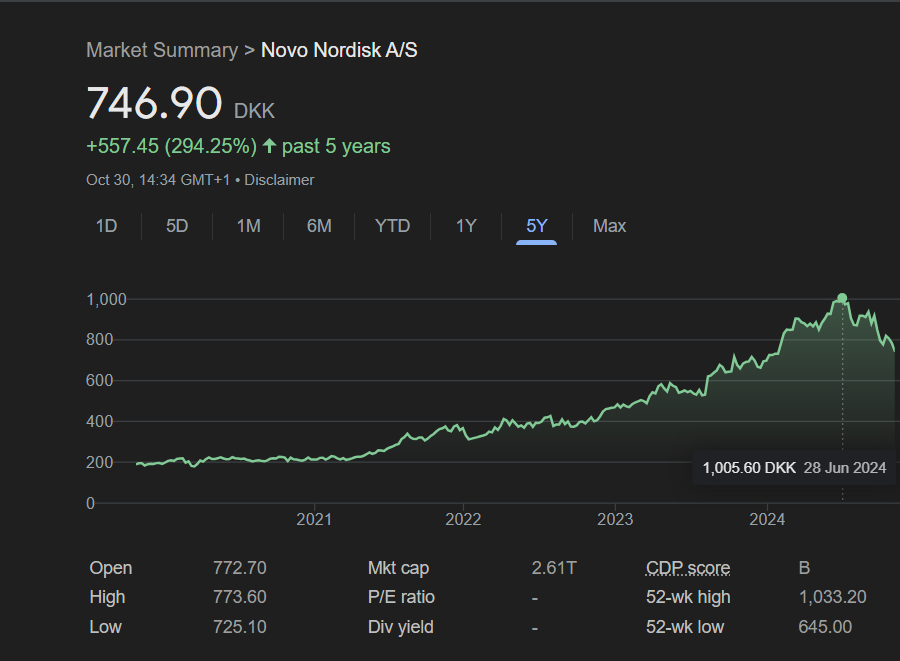
Novo Nordisk has performed steadily all these years, but specifically, the last 2 years were its prime years financially thanks to Ozempic. As we can see in the graph, Novo Nordisk reached its peak in June 2024. This makes sense because markets reacted to the “hype” of Ozempic earlier this year.
The rapid global growth of weight-loss drugs is evident in Novo Nordisk’s financials, last year its weight-loss drugs: Ozempic, Rybelsus, and Wegovy generated $21.1 billion, accounting for nearly two-thirds of the company’s revenue—89% increase from 2022. Of these sales, 71% came from the U.S.
But when we look at what is driving these sales a U.S. committee has criticized Novo Nordisk for its “outrageously high prices” for diabetes and weight-loss drugs. In the U.S., patients pay $969 monthly for Ozempic and $1,349 for Wegovy, compared to much lower prices abroad—$155 and $186 in Canada and Denmark. Novo Nordisk’s CEO Lars Jorgensen defended the pricing, noting that insurance varies by country and that most insured Americans pay $25 monthly for Wegovy. Despite recent stock drops due to disappointing study results, Novo Nordisk shares remain up 19% for the year.
Will the future get Ozempic?
Novo Nordisk’s competitor, Eli Lilly’s weight loss drug Mounjaro, currently approved for Type 2 diabetes, is awaiting FDA approval for obesity treatment, with expectations of further approvals for conditions like kidney and heart disease, sleep apnea, and even addiction. These expanded uses could significantly increase the patient population for these drugs, which are also being developed in pill form by both Eli Lilly and Novo Nordisk to appeal to the larger audience which may be scared of the injection format of the drug.
Insurers could be the key to expanding the market. With current costs over $1,000 per month without coverage in the US (the largest market for these weight loss drugs in the world), insurers mostly cover the drugs for diabetes rather than weight loss. But as these drugs show benefits beyond weight loss, like reducing heart disease risks, insurers might begin to expand coverage, making them more affordable for patients, thus more people purchasing the drug.
Analysts, including Goldman Sachs and JPMorgan, predict that weight loss drugs could become one of the best-selling drug classes ever, with potential annual sales reaching $100 billion by 2030, and I can’t agree more with their predictions, since that in the last few years the insulin market almost doubled or even tripled the stock price of Novo Nordisk.
– Emilija Zirnova