

France is a leading founding member of the European Union and one of the “engines” of the EU. However, France’s public debt is about 114% of GDP (in comparison, Latvia: 46.8%); this year the budget deficit in France is around 6% of GDP, well above the EU’s 3% ceiling (Latvia: 2.9%). Annual interest payments on the debt are approximately €67 billion. With extremely large public debt and its budget deficit France faces serious fiscal risks — this is a fundamental reason why Europeans cannot afford to ignore it.
How France came close to default
Political instability in the country has increased rapidly: France has had five prime ministers in the last two years. After the European Parliament elections in 2024, President Emmanuel Macron’s Renaissance party received just half of the votes in comparison with the National Rally, thus prompting Macron to call early parliamentary elections. Unfortunately, the new French parliament is even more fragmented; the National Rally won additional seats and gained even more influence. This political fragmentation of France makes it harder for any government to adopt the crucial budget decisions.
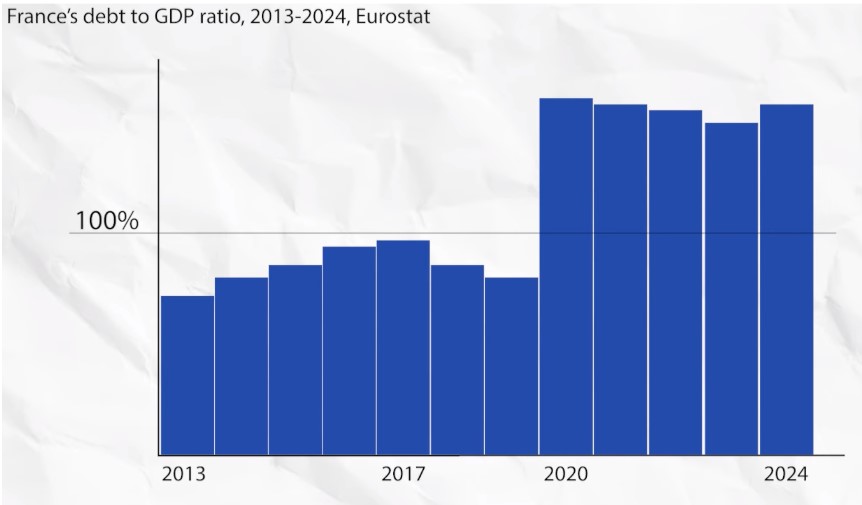
While politicians fight with each other, urgent decisions on spending have been delayed. Reduced Russian gas supplies since 2022 pushed energy prices higher and compelled the government to subsidize exposed industries. These subsidies have substantially increased France’s budget deficit and pushed debt higher. Public debt has risen faster than productivity, reducing the economy’s capacity to service this debt. On September 12, the credit rating agency Fitch and on October 18 Standard & Poors downgraded France’s sovereign rating from AA- to A+ due to concerns about the country’s ability to repay its debts. The downgrade of fiscal rating shows that France is experiencing the long-running problems, not just a one-time shock. As these problems continue, there is a serious risk of necessity for external support such as loan from the International Monetary Fund if borrowing conditions continue to deteriorate drastically. According to the OECD, France has the highest social spending and overall government spending percentage of GDP in the whole European Union. Pension system looks unsustainable; benefits are often higher than lifetime contributions. To stabilise public finances, recent prime ministers Michel Barnier and François Bayrou proposed spending-reduction reforms, such as reducing the number of public holidays and increasing the retirement age, but parliament rejected these proposals, and both prime-ministers were forced to resign. New prime minister Sébastien Lecornu will try again to reach a compromise with left wing socialist groups in parliament for the second time (October 22, 2025). However, the widespread protests and opposition from both the far-right National Rally and left-wing parties mean the budget is unlikely to be passed.
The widespread uncertainty has increased as investors have become more cautious in France’s financial markets. French medium- and long-term government bonds have become less popular, and yields have risen more than in other Eurozone countries as governments and financial institutions demand higher premiums for increased risk. For example, German 10-year yields are about 2.7%, while French yields are around 3.5%. Higher yields will increase France’s borrowing costs and will widen spreads with core euro-area sovereigns. If investors withdraw capital from France and choose other regions, that would create losses for French borrowers and banks exposed to French assets. Consequently, that means problems for French banks and borrowers can quickly spill over to other countries.
What this situation means for Europe?
France is the second-largest economy in the Eurozone; a crisis in France, in turn, would hurt the whole Eurozone’s financial stability. France has deep trade and financial ties with other EU countries, so problems in France could spread across the Europe. There is a risk that such shock could affect the other EU countries. Therefore, some experts expect that EU has to respond, but the ECB’s mandate prioritizes price stability and direct fiscal rescues would risk its independence and credibility. From a market perspective, the clearest global effect would likely be a weaker euro, raising import costs.
Unfortunately, France has not reduced its budget deficit to the levels agreed with the European Commission, which undermines its fiscal credibility comparing with other member-states. As an important trading partner, a weaker French demand would lower growth and export revenues for its EU partners. French political fragmentation and fiscal strain will increase the possibility that anti-establishment forces will gain influence, which would make EU decision-making more difficult and thus slow down the important decisions in the EU Council. Because France plays a key political and military role in the EU, a weaker France will not be only a Paris problem; it will reduce the bloc’s capacity to respond to major global challenges as well.
-Krišjānis Kristaps Kapustāns