
*Article written before the election
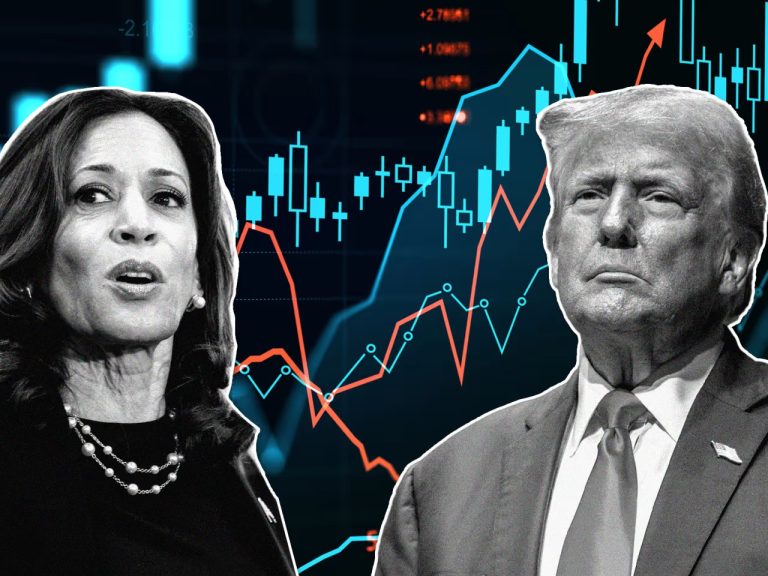
With the U.S. presidential elections already underway, for Wall Street it seems to be a quite bumpy journey. Investors have their eyes set on the candidates, Kamala Harris and Donald Trump, as each promises a very different direction for both the economy and the stock market. Let’s take a lighthearted tour of what might happen in each scenario, and why investors might want to keep some aspirin handy.
Markets if Harris Wins: Moderation with a Side of Capitalism
Picture Kamala Harris showing up to a party dressed in a suit, but telling everyone she’s “here to vibe and make connections.” That’s pretty much the energy she’s giving Wall Street right now. Despite earlier doubts due to her progressive stance in 2020, Harris is now schmoozing with corporate executives and making all the right noises about a strong business environment. She’s out there making calls, hosting gatherings, and convincing business leaders that she won’t set fire to their dividend checks.
Harris’s team, which includes well-known financial bigwigs like Jon Gray from Blackstone and Blair Effron from Centerview, is working overtime to connect her with Wall Street’s elite. She’s promising stability, sensible regulation, and just the right amount of capitalism to keep markets happy. Think of it as “smooth sailing capitalism”—not too risky, not too cautious, just steady enough to keep investors relaxed and confident in their portfolios.
Markets if Trump Wins: Here Comes the Tariff Tsunami
Now, if Trump wins, brace yourself for a different flavour of market mayhem. While Trump’s playbook might seem familiar—think tax cuts, deregulation, and chest-thumping about America First—it’s the prospect of new tariffs that has European companies on edge. Under a second Trump administration, industries like European luxury goods and automotive manufacturing are getting hit with some serious déjà vu vibes.
Investors have seen a sharp drop in stocks for European companies, like Volkswagen and LVMH, who rely on exports to the U.S. These industries are feeling the heat of what analysts call the “triple whammy”: Trump’s tariff threats, economic stagnation in the EU, and China’s slowdown. In essence, Trump’s renewed tariff rhetoric feels like the unwelcome return of a familiar adversary, and markets are reacting with all the excitement of a risk-averse investor looking at AirBaltic 14.5% bond coupon.
American Foreign Policy: From Neoliberalism to Nationalism?
While elections focus on domestic disagreements, let’s not forget the bigger game plan. Under Biden’s administration, we’ve seen a shift away from unrestricted free trade towards something that looks more like strategic autonomy. The U.S. is prioritising a strong industrial policy, emphasising local economies, and trying to break up global economic monopolies. This central point is about reducing dependency on state-run economies like China and Russia, and reinforcing local industries through targeted policies.
Expect Harris, if elected, to stick with this blueprint but with her own nuanced approach. The idea is to stop the one-way flow of economic power towards massive corporations and make trade rules that don’t feel like they were made by the CEOs of Big Tech over breakfast. Sure, Biden pulled the U.S. out of certain WTO negotiations, but it was in favour of creating more space for America’s unique policies and ensuring that the local economy gets the love it deserves.
Markets Will March On: Keep Calm and Stay Invested
If all this sounds like a lot of noise, that’s because, well, it kind of is! Elections tend to bring out the doomsayers and the eternal optimists, but here’s a reality check: the stock market is like a seasoned investor—it might have moments of panic selling or market corrections, but it knows how to readjust the portfolio and bounce back over the long run.
Looking back over the last century, regardless of who sat in the Oval Office, markets have shown a steady upward trend, averaging around a 10% return each year. So, whether Trump’s second term unleashes a storm of tariffs or Harris’s moderate touch charms the markets, history suggests that the stock market will still find a way to keep growing.
Investors might be tempted to make drastic changes based on the latest polls, but most financial experts recommend sticking to your plan. After all, shareholders are investing in companies, not politicians. And while tariffs, tax cuts, and policy shifts can certainly rattle the boat, trying to time the market is like trying to outguess your professor on an exam—it usually doesn’t end well.
Final Thoughts
In the end, elections can cause plenty of short-term volatility, but over the long run, markets tend to reward those who keep their cool. After all, if the markets could weather the 2008 financial crisis, a pandemic, and survive the meme stock mania of 2021, a little election drama is just another chapter in the rollercoaster of investing. Strap in, stay chill, and get ready to catch the next big wave—because this market is just gaining its momentum but we are here for the long run!
**Article written based on information as of 28th of October
– Martins Pumpurs